Infrastructure Technology

Maximising opportunities for digital change in project delivery and asset performance
Across the built environment, applications of new infrastructure technologies are emerging that are changing and improving how infrastructure projects are developed and delivered, helping to make the buildings we use more efficient and effective.
Our Infrastructure Technology (Infratech) team is supporting the adoption and investment in these technologies as well as the information management process to improve the whole-life performance of our infrastructure.
The Infratech team acts as a centre of expertise in digital and data management working across the public and industry sectors in the built environment to support whole-life asset performance and decision-making.
Maximising opportunities for digital across the public sector estate
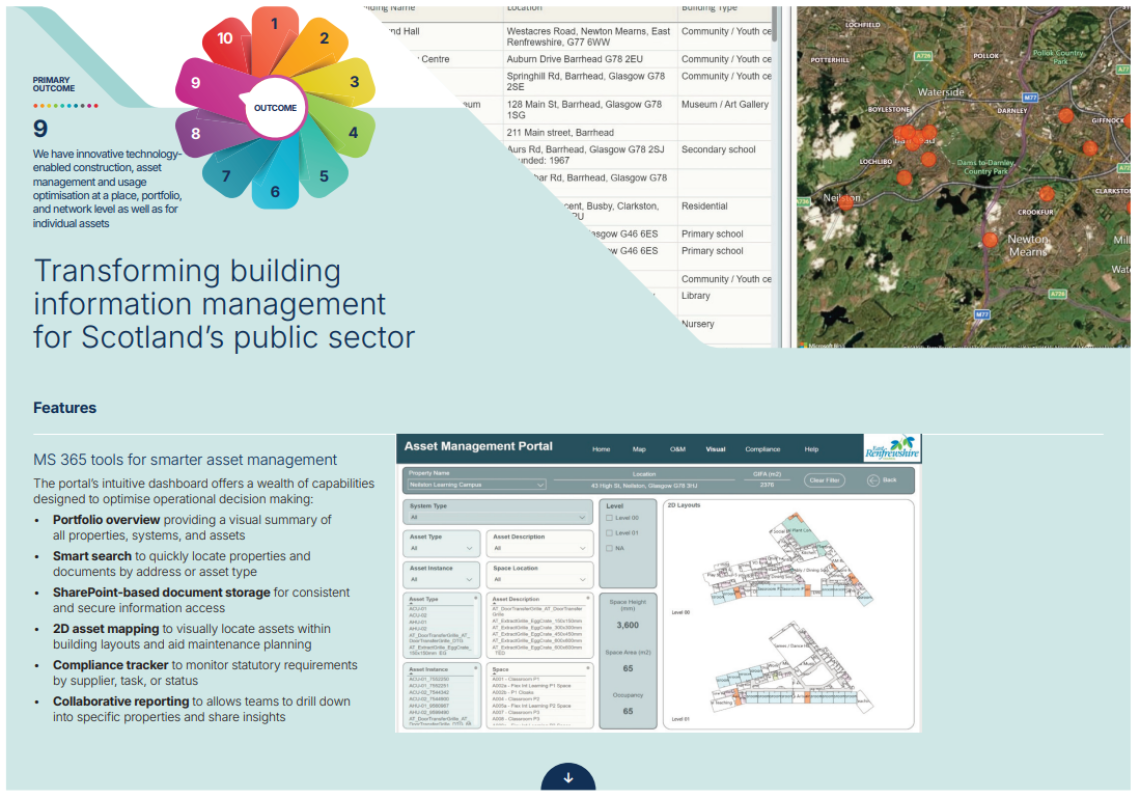
Over the past decade, Scotland has been on a journey to improve the way information is created, managed, and used across the public sector estate to improve insights and decision making. In the design and construction of new buildings, improved information management, supports better collaboration across the supply chain, reduces risk, improves efficiency, and enables teams to test building designs virtually before construction begins.
During operation, data and effective information management systems have the potential to significantly improve how the public estate is managed. Access to the right information at the right time can drive efficiencies, improve maintenance planning, reduce carbon emissions, and lower operational costs.
Our Infrastructure Technology team is supporting the adoption and investment towards a public sector digital estate that can improve whole life performance. The team acts as a centre of expertise in digital and data management working across the public and industry sectors in the built environment.
Building Information Management
BIM is the process of accurately creating, managing, and exchanging digital information within the built environment and is underpinned by a suite of International Standards. Key initiatives supporting this change and the adoption of BIM include:
BIM Guidance Portal - We have developed the BIM portal to provide guidance and best practices in the adoption of BIM within construction projects to realise the value of improved information management.
Standard Information Management Plan - In partnership with industry and public sector bodies, we have developed and launched the Standard Information Management Plan. This resource provides an innovative approach to delivering appropriate and consistent information requirements on public sector projects, with three key objectives:
- Support a consistent approach in how public bodies specify BIM and how information is digitally delivered to improve efficiencies and resilience during the asset lifecycle
- Enable the delivery of accurate as-built digital information models and operation and maintenance manuals to support effective asset management
- To align with new international standards in the organisation and digitisation of digital information management using BIM
Digital Estate & Asset Performance - Our Infrastructure Technology team has developed and delivered new initiatives and projects to support the wider digital transformation of the public sector estate to improve performance. That work includes:
- Digital Twin to Support Asset Performance - The growing digitisation of our build environment has developed a focus on the role and use of digital twins to provide greater insights into the operational performance and resilience of our new and existing infrastructure. This concept is the creation of an accurate digital version of the physical where data can be held, managed and monitored to improve performance. Examples of our work included the development of the A Guide to Smart Infrastructure for the learning estate.
- Public Sector Digital Estate & Infrastructure Working Group - In partnership public sector bodies, we support and facilitate a national working group on the areas of a public sector digital estate. The collectively vision for the group is: "The purpose of the Digital Estate & Infrastructure group is to support the investment, upskilling and implementation of value adding digital and information management processes to support efficient planning, design, delivery and management of the public sector estate."
Unlocking the value of data to improve decisions across the built environment
The Infrastructure Insights Lab helps the public sector make evidence-based decisions about places, buildings, and infrastructure. Combining data curation, advanced analytics, and visualisation, the lab turns complex information into clear, actionable insight - enabling policymakers and practitioners to understand trends, evaluate options, and anticipate future needs.
The lab curates reliable, consistent, and accessible datasets, then builds visual tools and scenario models that make this data meaningful. Interactive dashboards, spatial visualizations, and data storytelling surface both opportunities and risks across the built environment.
Beyond its technical capability, the lab is a collaborative space for innovation - supporting local authorities, government agencies, and public institutions to explore new approaches to planning and investment. By bridging data and decision-making, it strengthens the public sector's capacity to deliver sustainable, inclusive, and resilient outcomes for communities.
Data Challenges and Sprints
We support public sector partners with data challenge in the sector. We have developed a data sprint process to support partners develop data strategies, visualisations and insights into the data they hold. Examples of early work of data projects by the lab include the pilot projects of the PlaceTech Innovation Lab.
Infrastructure Data Tools, Library and Insights
We developed and maintain a number of tools and subsequent datasets to provide insights and help deliver improved outcomes for construction.
Construction Pipeline Forecast Tool
The Construction Pipeline Forecast Tool provides a look forward as to the anticipated public sector spend on construction. The forecast tool has been developed by the Scottish Futures Trust in partnership with industry and public sector bodies.
For any enquiries, please contact the administration team.
Community Infrastructure Benchmark Database
This Community Infrastructure Benchmark Database facilitates the sharing of construction-related project data amongst public sector organisations within Scotland.
For further guidance on how to use this database please refer to the information video or the Community Infrastructure Benchmark Database guidance.
For any enquiries, please contact the administration team.
Our team

Paul Dodd
Senior Associate Director
Paul leads the Infrastructure Technology and Improving Project Delivery teams having joined SFT in Aug 2012.
He is a quantity surveyor by profession having delivered cost and project management services on a variety of public and private sector projects.
During his time at SFT, he has held commercial and programme management roles within the hub programme and the Review of Construction Sector Procurement team.
His expertise is to derive value within the design, procurement and performance of assets and how information and technology can support this objective.
Contact Paul
Ryan Tennyson
Associate Director
Ryan joined SFT in 2019 to support the implementation of Building Information Management (BIM) in Scotland’s public sector.
His work has evolved into developing a standardised approach for digital information handover at project completion stages, to support improved asset management and lifecycle building performance evaluation.
His previous industry experience is in BIM consultancy, Design Management and Architecture roles, and he is a chartered Architectural Technologist and member of the Institute of Engineering and Technology where he sits on its Built Environment panel.
Contact Ryan
Claire Pollock
Associate Director
Claire joined SFT to support the collation, development, and management of multiple data sets, digital platforms, and best practice guidance, helping to improve business intelligence and support engagement with public sector colleagues and industry.
She has experience working within the planning sector as both a graduate planning advisor and data analyst responsible for product development and planning policy data collection and management.
Contact Claire